Tuesday, 12 February 2013

Every Living Thing: A Book Review

Every Living Thing: Man's Obsessive Quest to Catalog Life, from Nanobacteria to New Monkeys
by Rob Dunn
Harper 2010 ISBN 978-o-06-143031-2

“The biological world does not revolve around us... life is smaller than we imagined, ...we are a smaller part of life than we imagined,” and we occupy a “marginal position in the biological universe” (Every Living Thing p. 59 - 60). With Rob Dunn, you know where we stand. But from that marginal position, he's written a fascinating book about the life we share our planet with, and the key people who've helped us learn what we know about that life.

I found Every Living Thing to be a eye-opener in two ways. First, it reminded me forcefully that in spite of all that we know, we still don't know much. For someone who once believed (albeit a very long time ago) that all the answers were out there – you just had to go to the right library and ask the right question – it was both bewildering and liberating to realize that what we don't know is actually in the majority. To contemplate the vast quantity of scientific knowledge stored in academic libraries and realize that it is only the beginning is truly shocking.

'Animalcules' illustrated by
Anton van Leeuwenhoek; c1795.
Second, Dunn has illuminated the lives and accomplishments of some people who are frequently mentioned only briefly, even in the most interesting science books. I knew that Antonie van Leeuwenhoek discovered Giardia lamblia when he observed it in his own stool by looking through his own glass microscope lenses. I did not know that he was the first person known to observe microscopic life of any kind; that he discovered two entire kingdoms of life; that he was a family man with five children. I didn't know that two scientists who changed the world in very different ways – Lynn Margulis and Carl Sagan – were actually married to each other at one time. The book is full of surprises like that.

If there is anything that makes Every Living Thing a challenge, it's frequent jumps through time and space, and from third to first person narrative. Far from being chronological, the narrative draws unexpected connections throughout. The reader who is fully engaged and paying close attention will be fine. Others may feel suddenly disoriented and have to retrace their steps to find out how they got from 1960s California to 1848 Brazil; from first person contemplation of becoming a father, to endosymbiogenesis. The connections are relevant; they clarify and enlarge the picture, but it is, at times, quite a ride.

Dunn has a talent for explaining complex science in a way that the general reader can understand and he combines this talent with great storytelling. This grounds the people he writes about in a context of everyday life we can all relate to, and results in a very interesting and relevant science book. It's easy to imagine that Every Living Thing will end up in the reference section of a lot of personal libraries, including mine.


At one time, I was a great fan of Stephen Jay Gould, but today I'd have to say that both in print and online, Rob Dunn is my favourite science writer. I hope this strong beginning is just the first of many fascinating science books.

Tuesday, 5 February 2013

Was Joshua the Hero Of Jericho? (Schistosoma and Jericho)

The Jordan Valley near Jericho.
From the OSU Special Collections
and Archives.
Reform Judaism Magazine has published an adapted excerpt from my book Parasites: Tales of Humanity's Most Unwelcome Guests. The excerpt is a shortened version of my retelling of the story of Rahab, Joshua, and the Battle of Jericho, with the blood fluke Schistosoma hematobium as a central character.
 
Reform Judaism Magazine is an interesting publication. The online version features a number of articles that would appeal to any reader: titles that caught my eye include "Were the Jews Slaves in Egypt?," "The Divinity of Dementia," and "A Paragraph that Changed History" ("Why Jesus' last supper could not have been a Passover meal..."). Fascinating.

It's my pleasure to be published in this magazine. You can read Was Joshua the Hero of Jericho? on the internet.


Thursday, 31 January 2013

Echinococcus multilocularis Liver Cysts in Dogs

Infected foxes spread Echinococcus
multilocularis to dogs.
Image by Andy Potter; CC BY-SA 2.0.
As any good parasitology text will tell you, liver cysts caused by Echinococcus multilocularis typically occur in rodents: animals like voles, lemmings, and mice. The disease is called alveolar echinococcosis, or alveolar hydatid disease, and it occasionally occurs in people too, if eggs of the tapeworm are accidentally swallowed.

Echinococcus multilocularis liver cysts in dogs


The liver cyst caused by E. multilocularis is a larval stage - a stage that multiplies asexually in the cyst. The adult stage of the parasite is found in canids, members of the dog family: arctic foxes, red foxes, jackals, coyotes, domestic dogs. Thus, the 2009 discovery of a liver cyst in a domestic dog in British Columbia, Canada (Jenkins et al.), is puzzling and alarming.

This scenario is not actually so bizarre. Taenia solium, or pork tapeworm, has a similar story: humans normally host the adult tapeworm in the intestine after consuming the larval cysticercus in undercooked pork. But if a human swallows the tapeworm egg instead, the eggs hatches and the larva moves into the tissues – sometimes the brain – and forms a cysticercus.

When humans have T. solium cysticerci in their tissues, the disease is called cysticercosis – or, in the brain, neurocysticercosis – and this can be much worse than having the tapeworm in the intestine. Clearly, in a dog, a liver cyst that can grow large enough to compromise liver function, and spread to other parts of the body, is worse than hosting a tapeworm in the intestine as well.

In cysticercosis in humans, and presumably alveolar echinococcosis in dogs, the tissue cysts often originate from the hosts own intestinal tapeworms. In humans, it’s poor hygiene and hand to mouth transmission. In dogs, it’s grooming – licking eggs off soiled fur. This raises the question: have dogs always frequently had the liver cysts when they had the worms or has something changed?

Echinococcus multilocularis spreading to new places


Jenkins et al. remark that “compared with native North American strains, European strains of Echinococcus multilocularis appear to have greater potential to cause alveolar hydatid disease (AHD) in humans.” The strain found in British Columbia was a European strain; perhaps they have greater potential to cause AHD in dogs as well. Do we know?

The British Columbia dog apparently did not have the adult tapeworm in its intestine and the authors speculate that the parasite may have been introduced by an imported infected dog. This, too, is alarming. It brings to mind my discussion of E. multilocularis in Parasites: Tales of Humanity’s Most Unwelcome Guests, in which I relate the identification of Echinococcus multilocularis in wild canids smuggled into the Eastern US for fox hunting.

If one imported dog can introduce the worm to British Columbia, what is the likelihood that many illegally translocated infected canids have not spread the worm as well? Is alveolar echinococcosis simmering in rodents, dogs, and people in the eastern United States?

Sources


Jenkins EJ, Peregrine AS, Hill JE, Somers C, Gesy K, Barnes B, et al. Detection of European strain of Echinococcus multilocularis in North America [letter]. Emerg Infect Dis [serial on the internet]. 2012 June.

Roberts, Larry S., and John Janovy Jr. Gerald D. Schmidt & Larry S. Roberts’ Foundations of Parasitology 8th ed. Boston: McGraw Hill, 2009. Pg 354-5.

Thursday, 24 January 2013

Echinococcus multilocularis and Alveolar Echinococcosis

The tapeworm Echinococcus multilocularis normally spends its adult life in the intestine of a fox, usually an arctic or red fox. The fox acquires the worm by eating an infected rodent. In turn, the fox passes eggs in its feces, which rodents accidentally eat. In the intermediate host (the rodent or, sometimes, a human) the parasite occupies the liver rather than the intestine.

Alveolar echinococcosis


The adult Echinococcus multilocularis tapeworm is very
small. The head (or scolex) of this one is to the right.
Image: CDC
In the liver, the larva forms an alveolar cyst, a cyst composed of thin-walled chambers that multiply until the parasitic growth looks a bit like a mass of bubbles. These bubbles may break away and be carried to other parts of the body where they continue to grow. This is one reason why the alveolar cyst of E. multilocularis is often likened to a malignant tumor.

This is a nasty parasite and published accounts of the course of the disease in humans are rather horrifying. It spreads and is difficult to treat. It’s often fatal. This one, you never want to get. The literature and the media, meanwhile, lend the distinct impression that E. multilocualris is spreading and cases of alveolar echinococcosis in humans are becoming more common.

Distribution of Echinococcus multilocularis


A map in a 1984 parasitology text showing the global geographic distribution of E. multilocularis suggests that the worm has not broadened its horizons much in the last thirty years. In 1984, its range included most of Asia north of 40º latitude, Central and Eastern Europe, northern Canada, coastal Alaska, and a patch right in the middle of North America bisected by the Canada – US border and by 100º longitude. Today the distribution is marginally wider: more of Central Europe, parts of Western Europe, and the patch in the middle of North America has grown as well. Sporadic cases appear in other far flung regions: northern Africa, British Columbia in Canada.

So E. multilocularis is perhaps creeping rather than sweeping around the northern hemisphere. In truth, human infections are still extremely rare. Alveolar echinococcosisis, however, is “emerging” in humans in European locations, and there’s concern that it might do the same in parts of North America (most North American cases in the past have been in Alaska). In a recent paper in PLOS Neglected Tropical Diseases, Nahorski  and others report that, in Poland, only two cases were known prior to 1980, compared with 121 cases diagnosed between 1990 and 2011.

Why is alveolar echinococcosis increasing?


Better diagnosis is certainly one reason for the increase, and Nahorski et al feel that many undiagnosed cases remain. They point to another possible cause however - a boom in the urban fox population. “In Poland,” they write, “the fox population increased from 67 000 in 1995 to 220 000 in 2006.” That’s a very significant increase, and many of the human cases came from provinces where the worm is especially common in foxes. The data led the authors to conclude that infected domestic dogs and cats are also important sources of the disease.

In order for a domestic animal to acquire the intestinal worm, the animal would have to eat an infected rodent. Cats, of course, are hunters, but according to the European Scientific Council Companion Animal Parasites (ESCCAP): “Cats, in contrast to dogs, are epidemiologically insignificant as sources of egg output as they are poor hosts for this worm.” Dogs are a different matter: they are good E. multilocularis hosts, and many domestic dogs do hunt. Many do not of course, especially urban dogs. One would have to know one’s dog to judge the relative likelihood that it would ever have E. multilocularis eggs in its feces, or on its fur.
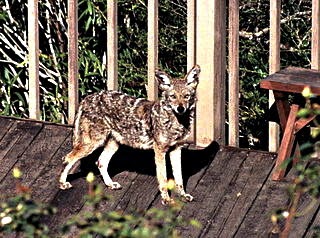
Urban coyotes have little fear of people.
Image by Steve Jurvetson, Menlo Pk, USA;
 CC by 2.0
Do foxes live in North American cities like they do in Europe? It’s true we don’t often read or hear about this, but they do: the city of Mississauga is one municipality that has addressed the issue of foxes in the city. And if those urban foxes have E. multilocularis, that could contribute to the emergence of alveolar echinococcosis in humans. But in North America, we have another canid that likes to live in cities, and it, too, can harbour E. multilocularis: the coyote. A study of urban coyotes in Chicago concluded that there are hundreds, perhaps thousands of coyotes living in that city, and those researchers believe that “the results likely apply to most major metropolitan areas in North America.”

So, while there's no reason to be paranoid about this rare disease, awareness of it isn’t a bad thing. All the usual advice still applies: wash your hands often, keep your dog close, and provide your dog with good veterinary care including screening for intestinal parasites.

Resources


Beaver, Paul C., Jung, Rodney C., and Eddie W. Cupp. Clinical Parasitology 9th ed. Philadelphia: Lea & Febiger, 1984. Pg 534.

City of Mississauga. Animal Services: "Foxes." 1995-2013

ESCCAP. “Worm Control in Dogs and Cats: ESCCAP Guideline 01 Second Edition.” September 2010

Nahorski WL, Knap JP, Pawłowski ZS, Krawczyk M, Polański J, et al. "Human Alveolar Echinococcosis in Poland: 1990–2011." PLoS Negl Trop Dis 2013; 7(1): e1986. doi:10.1371/journal.pntd.0001986

Wagner, Holly. “On the Loose: Urban Coyotes Thrive in North American Cities.” Ohio State Research News. Last Updated 2005.

Wednesday, 9 January 2013

An Epidemic of Absence: A Book Review

An Epidemic of Absence: A New Way of Understanding Allergies and Autoimmune Diseases.
By Moises Velasquez-Manoff.
Scribner; 2012 ISBN 978-1-4391-9938-1

“No matter who we are, we evolved with many more parasites and commensals, both large and small, than we generally encounter today. The implication—and let's face it, the hope—is that reestablishing contact with some of these organisms can rebalance the immune system.”

If Moises Velasquez-Manoff were to sum up his latest book, An Epidemic of Absence: A New Way of Understanding Allergies and Autoimmune Diseases, in under fifty words, the quote above would be a good choice (p. 61). In recent years, a growing number of researchers have explored the relationships between humans and the species that live with us—both those that cause disease and those that do not—and found evidence that we may be better of with many of them than without. Framing the information within his own experience of allergy and autoimmune disease, Velasquez-Manoff comes at this body of evidence from every conceivable angle, and by the last page one cannot help but be thoroughly convinced.


Studies show that regularly swallowing pig whipworm eggs
can alleviate symptoms of autoimmune diseases.
Image Bobjgalindo (enhanced) CC BY-SA 3.0


This topic, in the hands of someone suffering from allergies and autoimmune disease, could easily have come across as pseudoscience, but Velasquez-Manoff is meticulous about pointing out what is actually known through scientific research, and what is still theory or speculation. He deftly balances anecdotes with comments from reputable scientists and medical specialists, and his obvious grasp of the difficulties of proving causation lends the work great credibility. Similarly, his exploration of the “hookworm underground,” where individuals who are not medical professionals sell worm infestations to ill and desperate people, might have appeared sensational, but instead seems appropriate in the context of the narrative.


The examination of similar evidence from many different directions, however, occasionally makes one feel that the point has been made again. And again. By the time the author writes “Enough! What to do about it?” in the last chapter, the reader who has stayed the course is bound to breathe a grateful “yes!” This is not to say that the narrative is boring; it is not. But brevity is not its greatest charm.

One discussion in particular stands out from the rest of the book in both tone and relevance, and that is the author's detailed character assassination of Jasper Lawrence, one of the “hookworm underground” operators he meets. It's unclear why Velasquez-Manoff feels it's necessary to aim a stream of accusations – which may or may not be justified - at Lawrence. At best, Lawrence is anecdotal; he operates outside of mainstream medicine and doesn't contribute to the scientific literature. At worst, he's irrelevant. If the intent is to warn off anyone considering buying parasites from one of these companies, a clear explanation of the risks would have been a better choice.

An Epidemic of Absence is a good book about a subject that's likely to become more mainstream, and more important, as the science progresses. If you read nothing else, read the last chapter for the essence of the book. Then, if you want to understand it all thoroughly, start at the beginning and read the whole thing.

Wednesday, 26 December 2012

CBC Ideas - Worthy Parasites

Have you ever found a tiny parasitic pea crab living
inside your oyster? Some folks like to eat these too.
Image: NOAA
My CBC Ideas documentary, Worthy Parasites: A Villain's Silver Lining, will air for the first time on Jan 8, 2013, at 9 PM.

Regular listeners of CBCs Ideas, hosted by Paul Kennedy, know that the program can explore virtually any topic in science, history, the arts, culture, religion or anything else you can think of. Interesting, provocative, and contemporary, it's been on the air for decades and it's always worth a listen.

That's why I'm thrilled and honored to be the contributor of an episode that explores how species almost everyone loathes - parasites - are actually beneficial in many ways, even essential in our world. If you think parasites have no worth, think again, and listen to my one-hour episode in January.

CBC Ideas, Worthy Parasites: A Villain's Silver Lining is available on CBC Radio One across Canada: Tuesday, January 8 at 9 p.m. (9:30 p.m. NT) and Monday, January 28 at 2 p.m. (2:30 p.m. NT). It will also be live streamed and streamed on demand on the CBC website, and available as a podcast.

You'll be surprised by all the good things parasites do for you.

Ivermectin for Bedbugs

Would you take a drug to make yourself poisonous to mosquitoes, or black flies, or wasps? How about taking Ivermectin for bedbugs? I'm not so sure about this - the most obvious problem is that one would have to be bitten before it could work!

Ivermectin for Bedbug Infestation


Bedbug bites can be very uncomfortable.
Taking Ivermectin for bed bugs would
only work if every bug bit at least
once more!
A recent article on Bloomberg.com suggested that giving people oral Ivermectin for bedbugs might be an effective way of dealing with a bedbug infestation. A very small study (three people) found that most bedbugs died if they fed on someone within a day of a dose of Ivermectin, and that 54 hours after the dose, 42% of bugs died after feeding.

Treating people who aren’t sick with drugs has precedent: it’s common for people traveling in places where mosquitoes carry malaria, for example, to take an anti-malarial drug to avoid infection. But while malaria can easily kill you, bedbugs have never been shown to transmit disease to humans.

Ivermectin is an antiparasitic and obviously an insecticide. Like all drugs, it comes with a risk of side effects, some of them quite serious. Would it really make sense to expose large numbers of people – people who aren’t infected with anything - to this drug? It seems to me that treating a dwelling with insecticides is one thing – sometimes not a very good thing – but turning people into insecticide laden bug traps is another.

Bedbug Feeding Habits


Would it even work? Past research has indicated that bedbugs don’t feed every day. A 2009 study indicated that they might feed every two to three days and that they might synchronize their feeding (in other words, the bugs in a colony all tend to feed at the same time). Ivermectin is typically given as a single dose; how would we determine when it’s feeding day for the bedbugs? If the first twenty-four hours is crucial, you’d want to make sure you took the drug on the right day. And what if some survived or didn’t feed that day? And you’d need 100% participation from people staying in the dwelling. Imagine trying to do this in an apartment building. How many doses of Ivermectin would it take?

Finally, I suspect resistance would arise fairly quickly. If 42% of bugs died after feeding at the 54 hour mark, that means 58% survived – and they’d all been exposed to the drug. If their survival was due to them having more natural resistance than the other bugs, and they passed that along to subsequent generations, we’d see more and more resistance.

Before very long, the days of using Ivermectin for bedbugs would be over.


Sources


Gale, J. (2012) “Bed Bugs Dying After Merck Drug Suggests Possible Weapon.” Bloomberg.com

Reinhardt, K., Isaac, D. and Naylor, R. (2010), Estimating the feeding rate of the bedbug Cimex lectularius in an infested room: an inexpensive method and a case study. Medical and Veterinary Entomology, 24: 46–54. doi: 10.1111/j.1365-2915.2009.00847.x