Showing posts with label history. Show all posts

Tuesday, 1 August 2017

Amber Reveals Prehistoric Parasites Preserved in Blood

Perhaps 20 million years ago, a pair of monkeys in what is today the Dominican Republic sat grooming each other. Somewhere nearby, possibly in the tree where they sat, there was a sticky and probably aromatic collection of plant resin. This wasn’t an unusual jungle scene at the time, but what happened next was.

One of the monkeys discovered a tick feeding and already bloated with its blood meal. The monkey pulled it free. Something punctured the body of the tick – claws perhaps, or teeth - and monkey blood leaked out. Discarded, or dropped by accident (would the monkey not have preferred to eat this tasty morsel?), the tick fell into the resin and stuck there, still oozing blood.

The tick wasn’t the only organism to die in the resin that day. Within the tiny monkey red blood cells, there were piroplasms – parasites that multiply asexually inside blood cells, burst out, and invade new blood cells. Eventually, the process produces male and female forms that can reproduce only after being ingested by a tick, in a blood meal.*

​Fossil Red Blood Cells


The piroplasms ingested by the tick in this story never reproduced. Instead, they became fossilized in amber, along with the blood cells and the tick. All are still identifiable millions of years later. This piece of amber holds the only fossilized red blood cells from a mammal yet found; the parasites within them are an added fascinating treasure.

Like the tick in this article, this mosquito was discovered in amber in the Dominican Republic.
Image by Didier Desouens CC BY-SA 4.0 (not licensed for upload to Facebook)


Infection with Piroplasms: Babesia, Theileria, Cytauxzoon


Was the monkey sick? Possibly. The destruction of red blood cells caused by the multiplication of the parasites can lead to severe anemia and even death. Babesia bigemina is a notorious killer of cattle in the United States.  Theileria parva causes East Coast fever and death in African cattle. Cytauxzoon felis kills domestic cats in the United States. Some infections go unnoticed, however, and animals can develop immunity. It’s possible the monkey wasn’t all that bothered by its infection.

Throughout the ensuing millennia, ticks continued to bite mammals and infect them with piroplasms, and no one even knew it was happening until the early 1880s when Theobald Smith and Frank Kilbourne proved that a tick transmitted Babesia bigemina to cattle. Not only did they solve the mystery of what was causing Texas cattle fever, it was the first proof that creatures such as insects and arachnids (spiders, ticks, mites etc.) could spread diseases with their bites.

​It took about another 75 years before anyone documented a case of piroplasms infecting humans, and then only in humans who lacked a spleen. Caused by Babesia divergens, there were very few such cases, and the disease remained a medical rarity until recently. In 1969, Babesia microti began turning up in the United States in the same places where Lyme disease is emerging. Today, it’s a spreading infection in the United States and Canada, striking thousands of people every year, and killing some.

​Evolution of Babesia


Lots of people still haven’t heard of Babesia, much less piroplasms, and for the rest of us, they still seem quite new. So the discovery of organisms resembling Babesia sp. fossilized in amber that might well be more than 20 million years old is delightful.
Amber is fossilized tree resin.
It has unique properties for preserving
organisms that become embedded in it.
Image by Wibowo Djatmiko CC BY-SA 3.0
For all of that time, they’ve been evolving and adapting to their hosts until we finally became aware of them. We might never have known Babesia has been around that long if those two monkeys hadn’t stopped to pick off a few ectoparasites in the jungle so long ago.

​Photographs published in the report of this finding are tantalizing, though not as clear as a modern-day blood film. What they mostly do is make me want to sit down at a microscope and look at that magnificent piece of amber myself!

​*Researcher George Poinar Jr. can’t be absolutely certain that the animal the tick was feeding on was a monkey, or that the parasites in the blood are piroplasms; however, after considering other evidence – red blood cell and parasite characteristics, the fossil record, knowledge of primates, piroplasms, and other organisms alive today etc. – this is most likely the correct interpretation.


Read the paper in the Journal of Medical Entomology:

​Poinar, George, Jr. (2017) “Fossilized Mammalian Erythrocytes Associated with a Tick Reveal Ancient Piroplasms.” J Med Entomol tjw247. doi: 10.1093/jme/tjw247

​Further Reading About Babesia and Other Piroplasms


CDC. Surveillance for Babesiosis - United States, 2014: Annual Summary

 Drisdelle, Rosemary. 2017 "Babesiosis Cases Likely on the Rise." Outbreak News Today

Schmidt, Gerald D. and Larry S. Roberts. Foundations of Parasitology 8th Ed. New York: McGraw Hill, 2009.




Wednesday, 1 March 2017

A Revised History of the African Trypanosomes


Human African trypanosomiasis (HAT), or African sleeping sickness, was a smoldering disease before European colonization of the African continent. The famous American explorer Henry Morton Stanley has been blamed for spreading it across the tse tse belt of Africa from west to east in the late 1800s, setting off a series of epidemics that have killed millions and continue to this day. Similarly, nagana, the related disease in animals has prevented the rearing of livestock in the tse tse belt.


The tse tse belt of Africa. Trypanosoma brucei and the tse tse
fly are confined to this region. Image by Mba123; CC BY-SA 3.0
The tse tse belt, named for the blood sucking fly that inhabits its ecosystems, is pivotal in the history of the parasite. Trypanosoma brucei must complete part of its life cycle in the fly and the fly cannot live outside the tse tse belt; therefore, the parasite cannot either. Early theories suggested that the trypanosomes were originally parasites of insects that later invaded vertebrate hosts when the insects began feeding on blood.

African sleeping sickness is caused by subspecies of a protozoan parasite, Trypanosoma brucei. In his book Forgotten People, Forgotten Diseases, Peter J. Hotez sums up the long-accepted breakdown of the species: “T. brucei gambiense (T. b. gambiense) is the cause of human sleeping sickness in West Africa.... T. brucei rhodesiense (T. b. rhodesiense) causes HAT in East Africa.... A third subspecies, T. brucei brucei (T. b. brucei), does not infect humans.” Trypanosoma b. gambiense, we are told, does not infect animals. Trypanosoma b. rhodesiense infects both animals and humans. Trypanosoma b. brucei is death to domestic livestock.

Untreated, HAT is almost invariably fatal. Trypanosoma b. rhodesiense acts quickly, invading the central nervous system and bringing death within months. Trypanosoma b. gambiense causes a more chronic illness that can last for years. Because of this relatively milder course of disease, and because T. b. gambiense is said to infect only humans, it has been theorized that we have had it for much longer and are better adapted to it.

Much of this is probably wrong.

Where Did African Sleeping Sickness Come From?


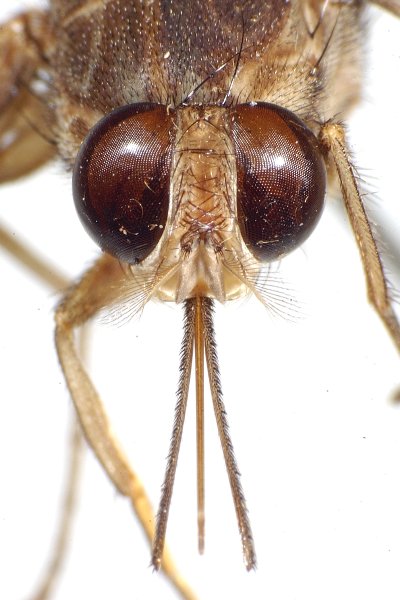
This tse tse fly is in the collection of the
American Museum of Natural History.
Image by Tam Nguyen. CC BY-SA 3.0

Today, genetic studies tell us that the African trypanosomes evolved in Africa, having diverged from T. cruzi, the agent of South American tryanosomiasis. Stevens et al date this divergence to about 100 million years ago, when the two continents separated. They write that the most likely scenario is that the ancient ancestors of these species were parasites of small early mammals, and later adapted to larger animals and the tse tse fly vector.

According to Stevens et al the ancestors of today's pigs and hippopotamuses were predominant in Africa until about 23 million years ago. “It is interesting,” they write “that several present-day trypanosome species are specific to pigs... and that analysis of tsetse blood meals indicates suids [pigs] to be a favourite food source.... The ecological requirements of tsetse and pigs (forest and thickets) are also very similar.” Perhaps HAT was a long-time disease of pigs that jumped to humans.

Investigators have found T. b. gambiense in various wild and domestic animals in the tse tse belt. Macleod et al, however, write that “the principal reservoir host for T. b. gambiense appears to be the domestic pig.” These findings lend further support to the idea that pigs may have been host to the parasite for thousands of years before humans were, and challenges the long-held belief that T. b. gambiense is an exclusively human parasite.

Subspecies of Trypanosoma brucei


Modern genetic analysis has revealed much about T. brucei. According to Balmer et al, the subspecies T. b. rhodesiense probably doesn't actually exist; rather, populations infective to humans are apparently populations of T. b. brucei that have acquired the serum resistance associated gene (SRA). Evidence suggests that this genetic mutation has evolved more than once and can be passed from one T. b. brucei population to another.

Meanwhile, T. b. gambiense apparently evolved resistance separately and shows less genetic diversity than T. b. brucei, suggesting that it infected humans and spread relatively recently. This again contradicts the idea that the subspecies has had a longer association with humans, which brings us back to the explorer Henry Morton Stanley.

Stanley and the Spread of African Sleeping Sickness


A map showing the main slave trade routes in Medieval times.
Runehelmet derived from Aliesin. CC BY-SA 3.0
Balmer et al don't suggest how recently T. b. gambiense might have spread, or where it started from. We know that HAT was present in northern Africa centuries before Stanley's expeditions: Arab slave traders from the 14th century left accounts of African slaves with typical symptoms. As well, Roberts and Janovy write that “swollen [lymph] nodes at the base of the skull were recognized by [European] slave traders as signs of certain death, and slaves who developed them were routinely thrown overboard...”

It appears, however, that HAT was not widespread in the tsetse belt, or at least it took few lives until after Stanley established shipping routes on the Congo River and helped the avaricious and brutal King Leopold II of Belgium to exploit the people and resources of what became the Congo Free State. If Stanley's exploits were the first steps toward epidemic HAT in the tsetse belt, Leopold's virtual genocide likely ensured that spreading trypanosomes upriver in human bloodstreams would precipitate disaster (even today, poverty and war in the tse tse belt bring epidemics of sleeping sickness).

 Stanley's last expedition started from the mouth of the Congo in 1887 and lasted about a year, but a 1904 New York Times article dates the beginnings of the HAT epidemic to about a decade after Stanley: “About six years ago,” the article states, “missionaries on the Congo began to write home of a mysterious disease which was ascending the river.” It was a wave of disease that would be “sure death to every person attacked by it.”
 

Further Reading About the History of African Trypanosomes


Alsan, M. (2012) "The Effect of the TseTse Fly on African Development." (2012)

Balmer O, Beadell JS. (2011) "Phylogeography and Taxonomy of Trypanosoma brucei." PLOS Neglected Tropical Diseases 5:2

Baumeister RF, and Tierney J. (2012) "Henry Morton Stanley's Unbreakable Will." Smithsonian.com Adapted from Willpower, by Roy F. Baumeister and John Tierney.
 
Cordon-Obras C, Berzosa P. et al. (2009) "Trypanosoma brucei gambiense in domestic livestock of Kogo and Mbini foci (Equatorial Guinea)." Tropical Medicine & International Health
14:5 535-541 doi:10.1111/j.1365-3156.2009.02271.x

Hoare CA. (1972) The Trypanosomes of Mammals. Blackwell, Oxford.

Hotez PJ. (2007) Forgotten People, Forgotten Places. Washington, DC: ASM Press

MacLeod A, Tait A et al. (2001) "The Population Genetics of Trypanosoma brucei and the origin of human infectivity." Philosophical Transactions of the Royal Society London 356, 1035-1044.

Yale University Genocide Studies Program. "Congo Free State 1885 – 1908." Yale University Genocide Studies Program. Accessed March, 2017.

Stevens JR, Noyes HA et al. (1999) "The Ancient and Divergent Origins of the Human Pathogenic trypanosomes, Trypanosoma brucei and T. cruzi." Parasitology 118: 107-116

Steverding D. (2008) "The History of African Trypanosomiasis." Parasites and Vectors 1:3

The New York Times. (1904) "Tens of Thousands Killed by a Tiny Fly." SM2